Pages

Wednesday, August 24, 2016

Walking along Chicken Alley


Yesterday evening at 6:00 pm, Paul and I joined the last Live Oak History Walk of the summer. Guided by two local historians Norman and Kathy Poitevin, over 62 of us walkers started at Live Oak School (1916 Capitola Road), and headed north along Chanticleer Avenue. 

Courtesy of Paul Titangos Photography

Chanticleer Avenue, or Chicken Alley, was officially recorded by Santa Cruz Sentinel on 13 July 1911. The road name originated from two sources: Edmond Rostand’s 1910 play, and home of early poultry ranches in the Chanticleer neighborhood.  The popularity of the poultry industry was a natural result of soil depletion, and lack of viable irrigation after previous 50 years' wheat and oat farming, and fruit and vegetable cultivation. Around 1910, Frank and David Wilson, two real estate agents, established the Wilson Bros. poultry company. They purchased several wheat farms and subdivided them into long and narrow new lots equipped with poultry units typically comprised of a 2-bedroom house, one or two coops and chickens. Those lots not only gave the neighborhood a unique land feature, but also defined its residents' occupations, and their families.

Courtesy of Paul Titangos Photography

We visited more than 22 houses built since the rise of chicken ranches on both sides of Chanticleer Avenue, with odd numbers like 1935 and even numbers like 1840. Interestingly, very few house owners were locals, but were from other states, or from countries such as Canada, Denmark, England, or Germany. Their former occupations varied too. But the new opportunity brought them here to work either directly in the poultry industry or indirectly for their families, working as butchers, real estate agents, school teachers, shopkeepers or bank-tellers or managers.

Courtesy of Paul Titangos Photography

At 7:30 pm, we completed our tour outside 2235 Capitola Road. The house owner was a little alarmed at first by our appearance, but immediately expressed his satisfaction at the mention of his house's fame. He is one of the few owners who are familiar with the long history about their homes. Moreover, there is a sharp contrast among the existing old houses: some houses are well-kept and well-preserved while others are dilapidated, and one, only a few days earlier, was torn down without an original trace.

Courtesy of Paul Titangos Photography
Full of local pride and well-being, Paul and I turned around and walked home to see our anxious Chippy and quiet home on the lot once inhabited by numerous hens and roosters.

 Courtesy of Paul Titangos Photography

Wednesday, August 17, 2016

Meeting Simon Vance & Jerusalem


Courtesy of Paul Titangos Photography

Yesterday evening, Victor, Paul and I attended an event jointly organized by SCPL and Recorded Books, LLC.

It was attended by a group of intimate but hardcore audiobook readers combined with fervent fans of author Alan Moore. Simon Vance, the reader of Moore's Jerusalem, started the evening by recalling his interviews with the writer about his "million-word" (in actuality, about 600,000 words) new publication. What was it about? What emphasis did he need to pay attention to? The audience was treated with the author's recorded answers.

After watching his live performance drawn from segments of a number of chapters, the audience asked Vance how he started his career as a narrator, his treatment of genders, his use of accents in books, his role in selecting reading material and his personal favorite authors and books. It turns out that Vance volunteered for a nonprofit organization recording books for the blind in the early 80s in Great Britain. Before long his unique voice was talent-spotted by the BBC, and later by Blackstone Audio, and Recorded Books. With his acting ability, he is known for bringing books to life with various characters. At the event, he revealed to his audience one secret to his success: consulting with writers whenever necessary. For instance one chapter in Jerusalem was extremely difficult to render. He contacted Moore again and found out that it was conceived in Irish. Accordingly he narrated in with the appropriate Irish accent, and the result was a success.

Vance has been narrating over 800 audiobooks over more than 3 decades and has won numerous awards. Like any Olympian, his accomplishment comes with both talent and hard work. The reading of Jerusalem is 57 hours long, but it took the entire month of June for him to complete the recording of the book. Even though he has limited say in selecting his reading materials, as Hollywood stars do, writers like Dickens and Proust remain his lifelong favorites. He loves a well-written book with well-created characters who make right choices, such as Hakan Nesser's Inspector Van Veeteren.

Courtesy of Paul Titangos Photography

The impatient audience wanted to know when they could listen to Jerusalem. It seems that they have to wait for a few more weeks, as its street date is 13 September 2016! Visit then at http://www.santacruzpl.org/ or http://santacruzca.oneclickdigital.com/ for a digital audio.

Tuesday, August 16, 2016

Narrator Simon Vance Visits Santa Cruz

Well-known audiobooks narrator Simon Vance is coming to Santa Cruz Public Libraries to discusses the upcoming Release Jerusalem by Alan Moore. He is a critically acclaimed narrator of over 700 audiobooks, winner of 53 AudioFile Earphones Awards, and a twelve-time Audie® Award recipient. The event is taking place tonight, August 16, 6:30 PM - 8:00 PM at 224 Church Street, Santa Cruz, California. A video clip about Simon Vance can be viewed at YouTube.

Monday, August 1, 2016

Lu Gusun (陆谷孙) Passed Away

Professor, lexicographer and Shakespearean scholar Lu Gusun's 陆谷孙 (1940-2016) passed away on July 28, 2016 in Shanghai. He was one of the most renowned celebrities Fudan has ever produced. His funeral service was fully attended, with white wreaths from city and state dignitaries.

In my four years' undergraduate study at the Department of Foreign Languages and Literatures, I was fortunate to have one translation class with him, when our regular professor was away. True to his name, he was extremely witty but kind, a very rare combination among professors of his status. Later my schoolmate was assigned to work for him, compiling the monumental English-Chinese Dictionary in the Academy of Social Sciences, next door to our Film Bureau. Since I left for California, I have not heard too much about Lu, except for his separate personal life with him in Shanghai and his wife and daughter in the States. A sad loss indeed.

Friday, July 1, 2016

Neary Lagoon Revisted

As planned right after my training yesterday noon, I went to meet Paul to have a last look at hundreds of goats at Neary Lagoon. I even took advantage of the training break to familiarize myself with the walking route from Center Street to the lagoon.

After paying the parking meter, we took off immediately. For some reason, we were greeted with an unusual silence and wafers of lingering smell.  'They are gone,' we could help but think. Our fear was soon confirmed by two ladies who were walking towards us. Like us, they were hoping to visit them again. Apparently our working goats were so diligent that they completed their work one day ahead of schedule. It was also apparent that they did a thorough job: wild and tall grasses and shrubs on both sides of the boardwalk were all chewed or broken to the ground. Before us were two long yellow stretches of land well manicured and fully fertilized.

With goats gone, we had to contend ourselves by walking along the quiet lagoon and watching wild ducks floating or grooming at the water's edge. It is simply hard to imagine a 44-acre park existing right between a wastewater treatment plant and a residential neighborhood in the center of Santa Cruz city, just like New York City's Central Park. According to City of Santa Cruz, Neary Lagoon is an important part of the urban watershed for the westside of the City of Santa Cruz. A drainage area of approximately 850 acres empties into the lagoon, and from there, out to the ocean.

Because of its well-maintained boardwalk, it is a heavenly access to Wheelchair Riders, "The 14-acre marsh includes a lagoon, which you can cross on a floating boardwalk, while enjoying close-up views of mallard and wood ducks, grebes, coots, and other birds. The boardwalk is part of a loop trail, used by both walkers and cyclists traveling between downtown and the west side of town ... Twice a year, goats and sheep are brought in to eat the invasive grasses, a delightful sight that I was fortunate to catch on my visit in mid-September."

Do I hear right, twice a year, goats and sheep will come to eat grasses? In that case, see you later!


Friday, June 24, 2016

Goats at Neary Lagoon

Since the West Zone Park supervisor's announcement that goats would be grazing at Neary Lagoon from June 21 to July 1, Paul and I decided to visit those guys, and we went last week.

For some reason we did not take the plank walkway on the right, but instead took a quiet dirt path on the left. The path led us to tranquil pools of water with numerous duck families floating on water or resting at the water's edge. Unlike the Canadian geese we normally saw at ponds or lakes, Neary Lagoon's mallards were small in stature.  They were not scared of us at all when we approached nearer.

Seeing the park entrance not far away, we pretty much gave up on our original plan of watching goats grazing. Just on the point of regretting our bad timing, we saw along the uphill fence hundreds of goats, of all ages and colors. As they were so quiet on the wetlands that we nearly missed them.


Known for their curiosity, some goats were indeed inquisitive, standing on their hind legs from time to time to poke their noses through the fence to see what it was like on the other side. Some were chewing on a shrub's branch collectively. Restrained by their tender age, babies were sunning very happily next to their mothers.


Photos courtesy of Titangos Photography

Since the visit, my mind has been busy: what a brilliant idea it is to let goats clean the wetlands and play in the sun! What is the difference between goats and sheep? I lost no time thanking the park supervisor and checking the web to locate 8 most agreed differences,

1. A goat is the more slender of the two, while a sheep is tubbier.
2. Sheep belong to the Ovas Aries species and have 54 chromosomes, while goats belong to Capra Hircus species and have 6o chromosomes.
3. A goat’s tail, for the most part, stands up while a sheep’s tail hangs down.
4. A goat is a typical a browser, feeding on leaves, shrubs, twigs and vines. A sheep, on the other hand, loves to graze on grass and clover.
5. Goats are curious by nature and are quite independent. A sheep on the other hand prefers to stay put in its flock.
6. While a goat has hair a sheep has fleece.
7. A goat has a beard while a sheep has a mane.
8. Wild goats are found wild in abundance and by all accounts sheep are entirely domesticated.

Tuesday, June 21, 2016

Summer Solstice Moon at Capitola by the Sea


At Paul’s suggestion, we revisited Capitola village right after dinner yesterday evening. It has been a long while since we visited Capitola Esplanade. At 8:10 pm, it was busy but not overcrowded on one of the longest days in the year. People sauntered either out of or going to various restaurants , young kids played on the beach, even though the same-day shark warning notices were posted on every post. We parked our RAV4, walked our usual rounds and finally reached Capitola Wharf. One idea was obviously on both our minds: where was the moon? 

Just a few steps on the wharf, we glanced at left and spotted a half pink ball on the horizon. That is our full moon! That is a true magic moment: a half ball soon turned into a full round moon rose steadily above the horizon and in the sky; the pinkness became light and deep golden with a long reflection on the water. Looking around, we saw people either watch in awe or trying to catch the moment with their hopeless phones. Even amateur fishermen stopped their busy hands at that moment. 

A rare realization dawned on us: why are we here? Is there anything better than this sublime moment?

Monday, May 16, 2016

On Zhang Ailing's Love in a Fallen City

Courtesy of SCPL Staff Picks ...

In 2007, New York Review Books published Love in a Fallen City (倾城之恋), a collection of seven novellas by famed Chinese writer Zhang Ailing (张爱玲). Originally published in 1943, it tells the story of a rapidly declining aristocratic family in Shanghai at the end of the 1930s. Not unlike Mrs. Bennet, the mother in Pride and Prejudice, the old matriarch is anxious to marry off her three grown-up daughters, especially Bai Liusu, the sixth daughter, whose ex-husband has just died, to eligible rich bachelors. Instead of succumbing to fate as a widow to claim a share of the inheritance or a future of shaving her hair to become a nun, the 28-year-old Liusu is determined to live her own life: "First marriage for the family, second marriage for oneself." Her half-sister, the seventh daughter, admires Liusu’s fiery and free spirit and chooses her as her companion for her first formal meeting with Fan Liuyuan, a wealthy Chinese heir from London. In a twist of fate, the sophisticated Liuyuan shows more interest in Liusu than in the intended betrothed. He engineers an invitation to Hong Kong for her. They fall in love after resolving a series of misunderstandings, and survive untold hardships during the 1941-1945 Japanese occupation.

The title story, which made Zhang Ailing the most popular new writer in Shanghai in the 1940s, displayed what became her literary trademarks: settings (Shanghai and Hong Kong), time periods (prior to and after World War II), characters (European or American educated intellectuals from declining aristocratic families), and themes (tension and uncertainty between love/freedom and societal restraints). She drew substantially from her real life experience, as reflected in her autobiographical novel Xiao tuan yuan (小团圆; SCPL has a copy in Chinese).

Despite her early success and later recognition as one of China's four female literary giants (along with Lü Bicheng, Xiao Hong, and Shi Pingmei), Ailing remains relatively unknown to today’s readers. Her first marriage, to a Japanese collaborator in the Sino-Japanese War, resulted in the banning of her books in Mainland China until recently. And, while a handful of her books have been translated into English, many subtleties have been lost in the process. However, Ailing's literary works transcend time and space with their penetrating language to portray "the desires, imaginations, and personalities of urban residents," (Encyclopedia Britannica). Meanwhile, their conflict between traditional Chinese culture and Western modernity is one of the constant themes favored by film/TV directors. Many of them have been adapted into movies, mostly notably, Love in a Fallen City (1984), Red Rose, White Rose (1994), and Half a Lifelong Romance (1997 as a film; 2003 as a TV series).

Monday, March 28, 2016

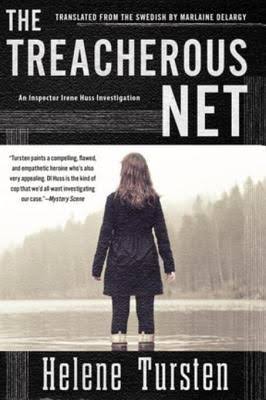
On the Treacherous Net


Many of our readers are familiar with Swedish author Helene Tursten. Her character, Detective Inspector Irene Huss, appears in a number of books, audiobooks, & DVDs in our library catalog. The Treacherous Net, her latest translated mystery, is a complex work, with an ambitious theme dealing with loneliness, the most widespread disease in Sweden, and modern society as a whole.

There are three concurrent storylines: a time-sensitive case to save teenage girls from an online predator; a mummified body discovered during a house demolition that triggers the reopening of a cold case from 42 years ago; and an intense workplace conflict between Huss and her new boss, Efva Thylqvist.

Loneliness, an internal poverty, is reflected fully in the book. Young teenage girls from both rich and poor family backgrounds turn to the treacherous Web for love and romance. But face-to-face interaction can be treacherous, too. Ever since her former boss was replaced by Thylqvist, Irene has experienced the taste of loneliness at work. She has been passed over and her input ignored. Worse, she has become isolated from her best friend/colleague, who was moved away from their shared office, and from the rest of her fellow officers, who have been won over by their attractive, seemingly hardworking new boss.

Faced with these challenges, Huss does not give in and quit her job, for she loves what she does. As the case progresses, Huss finds her true allies within and outside her department. And she surprises herself by finding the strength to speak out and give credit to the deserving when the new superintendent intends to grab all the glory herself. 

Saturday, March 12, 2016

On You Disappear


I have finished reading You Disappear by Danish novelist Christian Jungersen, but its impact is such that my mind simply will not let it go.

The story is straightforward: Mia Halling, a school teacher, is struck with a series of unpleasant surprises. One hot Mediterranean day during a family vacation in Majorca, her husband Frederik is driving so recklessly that he crashes the car, falls, and is taken to hospital. It turns out that he has been suffering from a brain tumor, possibly malignant. After medical consultation and treatment back in Copenhagen, Mia finds the black cloud of the cancer scare lifted, but is faced with a graver reality and its damage to her family. Frederik, the principal of Saxtorph Private School, has embezzled and lost more than 11 million kroner of the school’s funds, gambling on international commodity indexes. Erratic risk-taking behavior apparently is characteristic of orbitofrontal brain injuries such as his.

Unlike many a public official or private CEO who bankrupts their city or company and walks away without being held financially responsible, Frederik and other school board members have to face the consequences: take fiscal, as well as moral and political responsibility. They are obligated to sell their upscale houses and liquidate all their assets to make up for the misused funds. Even though Frederick has medical evidence that his behavior was caused by his brain tumor, he is likely to serve jail time.

Jungersen won Denmark’s Best First Novel Award in 1999 with Undergrowth. His next novel, The Exception, won two more Danish literary awards. I cannot wait to put my hands on these earlier books.

The review was originally published on SCPL Staff Picks.

My Blog Archive